Jackbit and UK gambling rules: what applies in Great Britain and Northern Ireland
 Available in GB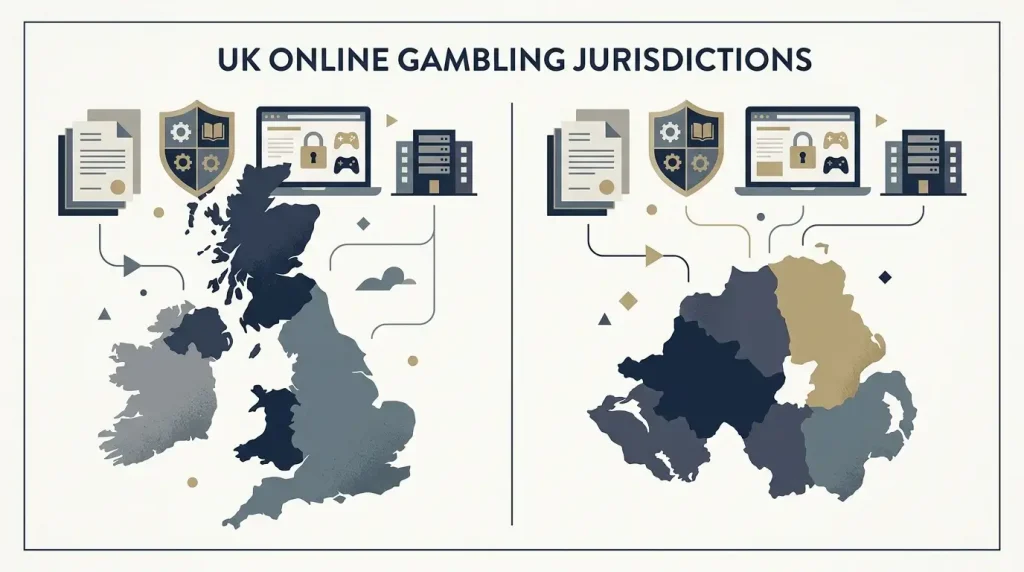
Table of Contents
- The regulatory split at a glance
- Great Britain and Northern Ireland use different frameworks
- UKGC rules are a benchmark for licensed Great Britain operators
- The £150 vulnerability threshold is not a deposit cap
- Online slot stake caps are £5 and £2 in Great Britain
- GAMSTOP participation follows UKGC licence coverage
- Credit-card rules matter when reading payment claims
- Gross deposit-limit rules change on 30 September 2026
- UK gambling winnings are generally tax-free for ordinary players
- The rules that matter to Jackbit readers
- Where Great Britain rules apply
- Which UK gambling rules matter when reading a Jack review
Section element
The first distinction is geographic. The Gambling Commission regulates most commercial gambling in Great Britain – England, Scotland and Wales – and operators providing remote gambling to consumers there need the relevant UKGC operating licence. Northern Ireland has a separate gambling framework under the Betting, Gaming, Lotteries and Amusements (NI) Order 1985 as amended in 2022. For Great Britain, a UKGC licence is a separate matter from the operator’s Curaçao record.
That means UKGC rules are useful as the benchmark for the licensed Great Britain market, but those protections do not automatically attach to Jack. For Jack’s current Curaçao record, see Jack licence and operator details. The useful comparison is between Jack’s current Curaçao record and the standards that apply inside the regulated Great Britain market.
Great Britain and Northern Ireland use different frameworks
The term “UK gambling law” can hide an important split. The Gambling Commission’s operating-licence guidance is written for Great Britain, meaning England, Scotland and Wales. It states that a business providing remote gambling facilities to consumers in Great Britain needs a Gambling Commission licence regardless of where that business is based.
Northern Ireland is different. Official Department for Communities guidance says gambling there is regulated under the Betting, Gaming, Lotteries and Amusements (NI) Order 1985, as amended by legislation passed in 2022. That is why a claim such as “UKGC regulates all online gambling throughout the United Kingdom” is too broad. The legal geography matters before any brand-specific conclusion is drawn.
UKGC rules are a benchmark for licensed Great Britain operators
Several consumer-facing rules are especially useful when reading a casino review. They show what a UKGC-licensed remote operator must do in the regulated GB market. They do not, by themselves, prove that an offshore operator follows the same rules.
| GB rule | Current requirement | How to read it for Jack |
|---|---|---|
| Remote operating licence | Required to provide remote gambling facilities to consumers in Great Britain | Check for an actual UKGC register entry rather than assuming a foreign licence is equivalent |
| Credit cards | Covered licensees must not accept credit-card payments for gambling, including through a money service business | Do not use a card logo or payment route as proof of UKGC status |
| Age verification | Remote operators must verify age before deposit, free-to-play gambling access or gambling with money or bonus funds | This is a GB licence standard, not a description of Jack’s own onboarding flow |
| Identity verification | Name, address and date of birth must be obtained and verified before gambling | Compare this with Jack’s separate risk-based KYC process rather than merging the two regimes |
| Multi-operator self-exclusion | Covered remote licensees must participate in the national scheme | Do not assume GAMSTOP participation without UKGC coverage |
For Jack specifically, the current public register does not establish UKGC licensing. UKGC identity rules, GAMSTOP participation and UKGC complaint protections therefore should not be treated as features of the Jack account. The correct comparison is between Jack’s actual licensing record and the standards that apply to businesses licensed for Great Britain.
The £150 vulnerability threshold is not a deposit cap
One of the easiest UK rules to misread is the financial vulnerability check threshold. The current Gambling Commission licence condition sets the threshold at net deposits over £150 in a rolling 30-day period. At that point a covered licensee must conduct a light-touch check using public-record information for indicators such as bankruptcy or certain debt judgments.
This is not a universal £150 monthly gambling limit and it is not a rule that automatically blocks further deposits at £150. The threshold triggers a specified check for UKGC licensees. It should also not be confused with the newer customer-led deposit-limit standards that are scheduled to change on 30 September 2026.
Online slot stake caps are £5 and £2 in Great Britain
The UKGC’s current online-slot guidance confirms a maximum stake of £5 per game cycle for customers aged 25 and over and £2 for customers aged 18 to 24. The £5 limit took effect on 9 April 2025 and the £2 limit for younger adults followed on 21 May 2025.
Those figures apply to online slots under remote casino operating licences. The Commission explicitly distinguishes slots from other casino games such as roulette and blackjack. For Jack, the limits are useful context for what a GB-licensed slot product must look like, not a basis for claiming that every game visible on Jack is governed by the same UKGC rule. For Jack’s catalogue and game categories, see Jackbit Games.
GAMSTOP participation follows UKGC licence coverage
The Gambling Commission’s remote multi-operator self-exclusion code requires covered remote licensees to participate in the national multi-operator scheme. For a consumer, that makes GAMSTOP a licence-linked protection: participation should be checked against whether the operator sits inside the relevant UKGC regime.
Jack should not be assumed to participate in GAMSTOP because the current UKGC public register does not show a matching licence for Jack, Jackbit or Data Link Digital B.V. Jack publishes its own responsible-gambling controls, including account limits, time-outs and self-exclusion options, but those operator tools are not the same thing as national multi-operator exclusion. Keeping the two concepts separate prevents a responsible-gambling feature from being mistaken for UK regulatory coverage.
Credit-card rules matter when reading payment claims
UKGC licence condition 6.1.2 prohibits covered licensees from accepting credit-card payments for gambling, including payments routed through a money service business. Commission guidance also says operators accepting e-wallets should ensure the funds used for gambling have not originated from a credit card.
This is why a list of globally supported card brands is not enough to establish a valid Great Britain cashier route. The Jackbit Payment Methods for UK Readers page separates Jack’s current crypto-first wallet structure from payment methods that may appear in older Jackbit material or third-party on-ramp flows. A UK reader should distinguish a card used to buy crypto from a direct credit-card gambling deposit.
Gross deposit-limit rules change on 30 September 2026
As of 25 September 2026, the second stage of the Gambling Commission’s financial-limit changes is still future-dated. The Commission says that from 30 September 2026 covered operators must offer gross deposit limits, describe only qualifying gross limits as “deposit limits”, and give those limits at least equal prominence to other financial-limit types.
The effective date matters: on 25 September 2026, the 30 September rule change is still scheduled rather than in force. From 30 September 2026 onward, the current Gambling Commission position should be consulted before relying on this dated description.
Date-sensitive rule
The 30 September 2026 change shows why the effective date must stay attached to regulatory information. Current rules and announced future rules should not be blended into one undated list.
UK gambling winnings are generally tax-free for ordinary players
HM Revenue & Customs guidance says gambling winnings from wagers and bets are not taxed as miscellaneous income. For an ordinary customer, that supports the practical summary that gambling winnings are generally tax-free in the UK. It does not mean every financial situation involving gambling-related activity is automatically outside tax rules, so professional or business circumstances can require separate advice.
The tax point is independent from whether an operator is locally licensed. It should not be used as a signal that a particular casino is authorised in Great Britain.
The rules that matter to Jackbit readers
Start with the exact claim rather than a broad label. If the claim is about UKGC licensing, check the Gambling Commission register. If it is about a bonus, read the current Jackbit Bonus and do not infer eligibility from a general promotion headline. If it concerns payment routes, compare the live cashier with the Great Britain credit-card restriction. If it concerns a game, distinguish UKGC slot rules from roulette, blackjack or live dealer products.
This method is more useful than asking whether a casino is simply “UK” or “not UK”. It separates licensing, product rules, payment restrictions and account safeguards so that each statement is tied to the regime that actually creates it.
The overall Jack.com product and regulatory context is introduced in complete Jackbit casino review.
Where Great Britain rules apply
Current Gambling Commission material sets out the Great Britain licensing rule, credit-card condition, identity verification requirement, self-exclusion code, £150 financial-vulnerability threshold, online-slot stake limits and the scheduled 30 September 2026 financial-limit changes. The Department for Communities explains Northern Ireland’s separate framework, and current HMRC guidance covers ordinary-player tax treatment.
Which UK gambling rules matter when reading a Jack review
For a reader in England, Scotland or Wales, the most important distinction is whether a claim belongs to the UKGC-licensed Great Britain market or to Jack’s own Curaçao-regulated product. UKGC rules set clear expectations around licensing, age and identity checks, credit-card payments, GAMSTOP, financial-vulnerability checks and slot stake caps, but those protections should not be attached to Jack without the relevant register evidence. Northern Ireland must be considered separately because it operates under a different statutory framework. Treating each rule as a specific jurisdictional fact avoids collapsing the whole UK into one licensing label.
Recommend

Jackbit Licence and Operator: Curaçao status, UKGC check and trust facts
Jackbit UK Guide Section element Data Link Digital B.V. and OGL/2024/1562/1139 appear in the current...
Jackbit Sportsbook: how Jack's betting product fits beside the casino
Jackbit UK Guide Section element Sportsbook product check - 25 September 2026 The sportsbook is...

Jackbit Bonus: 100 free spins and the terms UK readers need to check
Jackbit UK Guide Section element Current Jack.com welcome-promotion screen; deposit and promotion terms can change....

Jackbit Registration: account setup after the move to Jack.com
Jackbit UK Guide Section element Current Jack.com signup interface showing the fields used to open...

Jackbit Games: slots, tables, live casino and providers
Jackbit UK Guide Section element The real current lobby is the best way to show...

Jackbit Payment Methods for UK Readers: deposits, GBP and crypto
Jackbit UK Guide Section element Current Jack.com cashier view; payment availability can vary by account...

Jackbit App and Mobile Play: browser, web app and safe access
Jackbit UK Guide Section element Current Jack.com mobile web installation route. The current official mobile...

Jackbit to Jack.com: what changed in the May 2026 rebrand
Jackbit UK Guide Section element The account relationship continued under the Jack.com name; current terms...