Jackbit Registration: account setup after the move to Jack.com
 Available in GB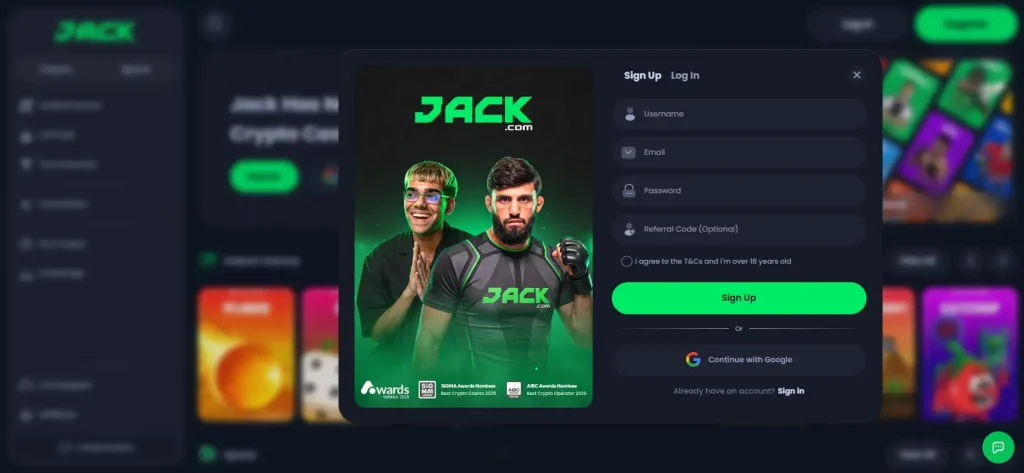
Table of Contents
- What registration currently means
- Jackbit registration now starts on the Jack.com platform
- The current signup form is deliberately short
- Fast account creation and later KYC can both be true
- What UK readers should compare with domestic onboarding
- Registration is only the first account checkpoint
- Use the current brand route for login and account recovery
- How registration connects to mobile use
- Account security and access essentials
- Returning to an existing account
- Before creating a second profile
- Registration details and later account activity
- What a new Jack account actually asks you to do
Section element
Jackbit became Jack.com on 29 May 2026, so a new Jackbit registration now means creating an account on the current Jack platform rather than opening a separate legacy Jackbit account. Jack’s current registration material shows a short signup form built around a username, email address and password. Existing Jackbit users were not asked to start again: current brand material says accounts, balances and VIP tiers carried over in the transition.
The important qualification is that a quick signup is not the same thing as a permanently KYC-free account. Jack can request identity checks later on a risk basis. For a UK reader, that makes registration best understood as the start of the account relationship, not proof that no documents can ever be requested.
Jackbit registration now starts on the Jack.com platform
The first point to get right is the brand transition. Jackbit completed its move to Jack.com in May 2026. This was not presented as a separate casino requiring legacy users to rebuild their accounts from zero. Jack’s current material says existing accounts, balances and VIP status carried across, while the interface and name changed.
That matters because search results still contain the old Jackbit name, older images and exact-match domains that are not the current operator site. If you already had an account, the practical task is account access under the current brand rather than another sign-up. For the rename and account continuity, see the Jackbit-to-Jack.com transition guide.
The wider Jackbit account and product picture is available in complete Jackbit casino review.
The current signup form is deliberately short
Jack’s current official registration guide describes the standard form as three core fields: username, email address and password. That is a materially lighter front door than the multi-stage onboarding used by many gambling sites. The practical advantage is obvious: there is less information to enter before the account exists.
There is also an important limit to what can be inferred from that short form. A field not requested during registration is not proof that the operator will never ask for it. Jack explicitly separates quick onboarding from later identity checks. That is why phrases such as “no ID at signup” and “no KYC ever” should not be treated as interchangeable.
Do not copy old registration walkthroughs blindly
The form shown at signup is the form that matters. If an older Jackbit page tells you to enter a phone number, postal address or another field that is not visible in the current flow, follow the live Jack interface rather than an old step-by-step article.
Fast account creation and later KYC can both be true
Jack describes its verification model as risk-based. In practical terms, the platform can let a user create an account without uploading identity documents and still reserve the right to request them later when account activity triggers a review. A withdrawal, an unusual transaction pattern or another compliance signal can therefore introduce verification after an initially low-friction signup.
This distinction is the most useful thing to understand before registering. If your decision depends on never submitting documents, a quick registration screen does not establish that outcome. The separate Jackbit KYC guide explains the document categories currently named by Jack and why no fixed trigger amount or review time should be assumed.
What UK readers should compare with domestic onboarding
For context, remote operators licensed by the UK Gambling Commission follow a different onboarding benchmark in Great Britain. UKGC rules require age verification before a customer can deposit or gamble, and Licence Condition 17 requires core identity information including name, address and date of birth to be obtained and verified before gambling is permitted.
That benchmark is not Jack’s own licensing rule. Jack’s current public materials identify a Curaçao licensing context. The UKGC comparison is useful because it shows why onboarding at a UKGC-licensed remote casino can look different from Jack’s current signup. These UKGC rules are a domestic benchmark only, not Jack’s own licence requirements.
Registration is only the first account checkpoint
Once the account exists, the next practical decisions are funding, account security and understanding the route back out. The Jackbit Payment Methods for UK Readers guide explains the current crypto-first cashier model and why seeing GBP in an interface does not automatically mean a direct UK bank or card deposit rail is available.
Use a unique password, retain access to the email address used for registration and enable any security controls offered in the live account. If you later change devices, lose access to email or trigger a verification review, having accurate account details makes recovery simpler. Avoid sharing passwords or one-time security codes with anyone claiming to be support.
Use the current brand route for login and account recovery
Legacy searches such as “Jackbit login” can surface third-party sites that use the old brand name. That creates a basic navigation risk: an exact-match domain or copied login page can look relevant without being the current operator. Use the current Jack.com brand route, check the address before entering credentials and reach support from the live site rather than from a link posted in a forum or unsolicited message.
If a legacy bookmark redirects to the current brand, verify the destination before signing in. If login fails, do not create a second account simply to bypass the problem. Use the platform’s current recovery route or official support so the issue is handled against the existing account record.
How registration connects to mobile use
The same account credentials are relevant when moving between desktop and mobile browser access. You do not need a separate account just because the screen size or device changes. For the current mobile route and installable web-app option, see Jackbit App and Mobile Play.
For account security, treat a new device as a reason to check the address bar and account notices carefully. A mobile screen can make it harder to inspect a full URL, so open the current brand route directly instead of following a shortened or unfamiliar link.
Account security and access essentials
| Step | What to do | What not to assume |
|---|---|---|
| Find the current site | Use the Jack.com brand route and check the destination | That an old Jackbit-named domain is official |
| Create the account | Use the fields shown in the current signup flow | That old walkthrough fields are still required |
| Secure access | Use a unique password and retain access to your email | That support will ever need your password |
| Plan funding | Check the live cashier before sending money | That GBP display equals a direct GBP deposit method |
| Plan for verification | Know that KYC can be requested later | That low-friction signup guarantees permanent no-KYC use |
Returning to an existing account
Jack’s registration information describes the initial username, email and password flow. The brand transition carried existing accounts forward, so a returning Jackbit user should use the current account route rather than creating a replacement profile simply because the name changed.
Before creating a second profile
Anyone who used the old Jackbit name should start by considering whether an existing account already belongs to the current Jack.com platform. The rebrand announcement described account continuity, so registering again purely because the branding changed can complicate recovery and account history. Where access is lost, use the account-recovery route shown by the current service rather than inventing a new username to bypass an old login.
Keep the email address associated with the account available and pay attention to messages inside the logged-in service. If the email account itself is inaccessible, the steps for changing it can differ from a routine password reset. A secure account-recovery conversation should concern your own account details; never send a password or one-time code in response to an unsolicited message claiming to help with a migration.
Registration details and later account activity
A username, email address and password establish an initial account, not the complete set of information that might become relevant later. Correct details matter when a payment request or an identity request needs to be associated with the right person. Do not rely on a display name or the old brand name as proof that the operator has confirmed identity.
If you move between desktop and mobile, the sensible test is whether the same account shows the expected balance and history after a secure sign-in. A saved browser icon is only a route to a website; it is not a separate wallet or another account. The distinction is particularly useful after the change from Jackbit to Jack.com.
What a new Jack account actually asks you to do
The current signup is short: choose a username, provide an email address and set a password. That speed is useful, but it does not remove the possibility of later identity verification. Legacy Jackbit users should treat Jack.com as the current account destination rather than opening another profile by default. For a UK reader, the practical approach is to verify the current domain, secure the account, inspect the live cashier before funding and be prepared for KYC if the account is later reviewed.